
Key takeaways
- A towel bar is not a grab bar, even if it looks sturdy.
- The fastening into the wall matters more than the bar itself.
- Tile is drilled slowly with the right bit, and every hole sealed.
- Place bars by watching how the person moves, not by a diagram.
In this guide
A towel bar is not a grab bar
Towel bars, soap dishes and toilet paper holders are fastened with small screws and light anchors. They hold a towel. When someone slips and grabs one, it pulls out of the wall, often taking tile with it. A grab bar is built and mounted to carry a person's weight. The ADA standards, written for public buildings, require a grab bar and its mounting to withstand 250 pounds of force; for a bar at home, look for a rating at least that high on the packaging.
Some makers sell bars that double as towel bars or shelves and are rated as grab bars. Those are fine. A decorative towel bar is not.
What holds it is behind the wall
The strongest mounting is screws into the wall studs or into wood blocking, solid pieces of lumber fastened between studs. Blocking is easy to add while a wall is open; if you are remodeling a bathroom, ask for blocking at every spot a bar might ever go, even if no bar goes up now.
Studs do not always fall where a bar is needed. In that case, use anchors made and rated specifically for grab bars, installed exactly as their instructions say. Plastic expansion anchors and general-purpose drywall anchors are not acceptable for a grab bar. Every flange on the bar should be fastened, and once it is up the bar should be pulled on firmly in every direction before anyone relies on it.
Drilling through tile without cracking it
Behind the tile there is usually backer board and sometimes a waterproofing membrane. Each hole goes through that layer, which is why sealing every hole matters as much as the strength of the fastener.
- Put painter's tape over the spot so the bit does not wander.
- Use a bit made for the tile: carbide for ceramic, diamond for porcelain and stone.
- Drill with the hammer setting off, at slow speed, with light pressure.
- Keep porcelain and stone cool with a little water while drilling.
- Fill each hole and the screw threads with silicone before fastening, so water cannot get behind the tile.
Need grab bars that hold? Tell Daniel about it
Placement: where hands actually go
The ADA standards place horizontal grab bars in public restrooms 33 to 36 inches above the floor. In a home, that is a starting point, not a rule. The right place is where the person who uses the bathroom naturally reaches.
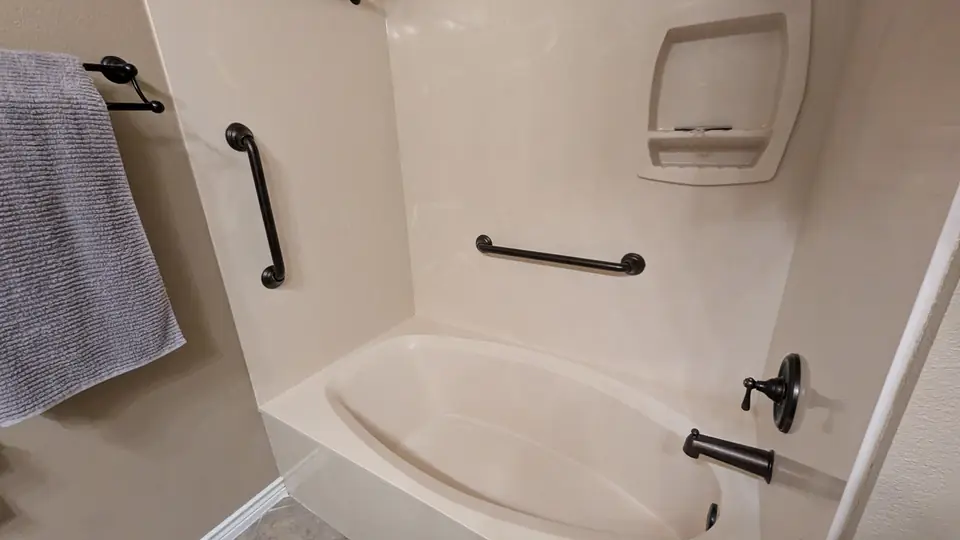
Have them walk through the motions with the water off: stepping over the tub edge, turning in the shower, sitting down on and standing up from the toilet. Mark where the hand goes. Common spots are a vertical bar at the tub or shower entry for stepping in and out, a horizontal bar along the back or side wall of the tub, a bar within reach of a shower seat, and a bar on the wall beside the toilet.
Two more checks before drilling. A bar near the shower valve must not get in the way of reaching the controls, and the valve wall has pipes running above and below the handle, so plan screw locations away from them. The bar should also be easy to close a hand around for the person using it.
Aging in place: the rest of the bathroom
Grab bars are one part of a safer bathroom. Other changes that help: a handheld shower on a slide bar, a shower seat, lever handles that are easier to turn than knobs, a night light on the path from the bedroom, non-slip mats, and sturdy handrails on any steps in the house. Handrail and stair work, furniture anchoring and grab bar installs are all on Daniel's list of services.
A loose grab bar: stop using it
A grab bar that moves, even a little, should not be used until it is fixed. The cause is usually anchors that were never rated for the job, screws that stripped, or wood blocking softened by a leak. The repair is to remove the bar, look at what is behind it, and remount it into framing, new blocking or rated anchors, or move it to sound wall.
To plan an install, send The DFW Handyman a photo of each wall, the wall finish (tile, fiberglass or drywall), and a note on who will use the bars and how, through request service. See grab bar installation for details.