
Key takeaways
- Test every railing by pushing firmly at the top rail and the posts; any movement needs repair.
- Rust where posts enter concrete is the most common failure, and it is often worse than it looks.
- Paint can be done in place; powder coating and galvanizing require removing the railing to a shop or plant.
- New or replacement railings may need to meet current code, so check with your city.
In this guide
A loose railing comes first
A railing's whole job is to hold when someone leans on it or grabs it after a misstep. Older family members and guests rely on it more than anyone. Grab the top rail at several points and push firmly in each direction, then do the same at each post. A railing should not move.
If it does, treat it as a repair to schedule soon, and let the household know not to lean on it in the meantime. The cause is usually at the base of a post, at a wall bracket, or at a broken weld.
Rust at the base: the usual culprit
Many railings on front steps and porches were installed by setting the posts into holes in the concrete. Water runs down the post, collects in the hole and keeps the steel wet. The rust that forms there is hidden, and as rust expands, it can crack the concrete around the post.
Look for rust stains running down the step, cracks radiating out from a post, paint bubbling just above the concrete, and a post that moves when pushed. By the time a post is loose, much of the steel below the surface may be gone.
The repair is to cut out the rusted section and weld in new steel, or to switch to a base plate bolted to the surface of the step. If the post goes back into the concrete, the hole is filled with a non-shrink grout shaped to shed water away from the post. Cracked concrete around the post may need its own repair.
Other common repairs
- Broken welds at joints between rails, posts and balusters
- Bent balusters straightened or replaced
- Missing scrolls, collars or finials matched to the existing pattern
- Loose wall-mounted handrail brackets re-anchored into solid material
- A new handrail added where steps have none, made to match existing ironwork
- Rusted metal steps or stringers at an entrance reinforced or rebuilt
Railing loose or rusting? Tell Daniel about it
Refinishing: paint, powder coating or galvanizing
Many railings called wrought iron are actually mild steel, and all of them need a coating to keep water off the metal. There are three common options.
Paint is done in place. The result depends on preparation: loose rust and flaking paint removed with wire brushes and grinders, a rust-inhibiting primer on bare metal, then exterior-grade metal paint. Paint is easy to touch up, but it needs attention more often than the other two.
Powder coating is a dry powder applied electrostatically and baked on in an oven. It gives a tough, even finish, but the railing has to come off and go to a coating shop. Chips must be touched up quickly, because rust can creep under the coating from a damaged spot. When powder coating peels, the usual causes are poor surface preparation, moisture or rust under the coating, or coating over galvanized steel without the right prep.
Galvanizing is a zinc coating applied by dipping the steel in molten zinc at a galvanizing plant. The zinc protects the steel even where it is scratched. The natural look is dull gray, so galvanized steel is often painted or powder coated over for color, which takes proper preparation. For new pieces that will sit in sprinkler spray or near soil, galvanizing is worth considering in Texas weather.
When replacement makes sense
A new railing can be fabricated to match existing ironwork elsewhere on the house, or designed fresh for the stairs. Height and opening rules may apply to new railings, and a permit may be needed, so check with your city's building department before replacing one.
- Rust has eaten through many balusters, rails or posts, not just the bases
- The steps or porch around the posts are too damaged to anchor a railing solidly
- The railing is too low or its openings too wide by today's standards, and you would rather replace than add to it
- You want a different style, such as replacing a dated design with a simple black steel railing
- Repairs would mean rebuilding most of the railing anyway
Getting it done
Send a photo of the full railing, close-ups of each post base, and the length of the run. That is usually enough to tell whether the repair can be done in place and which finish makes sense.
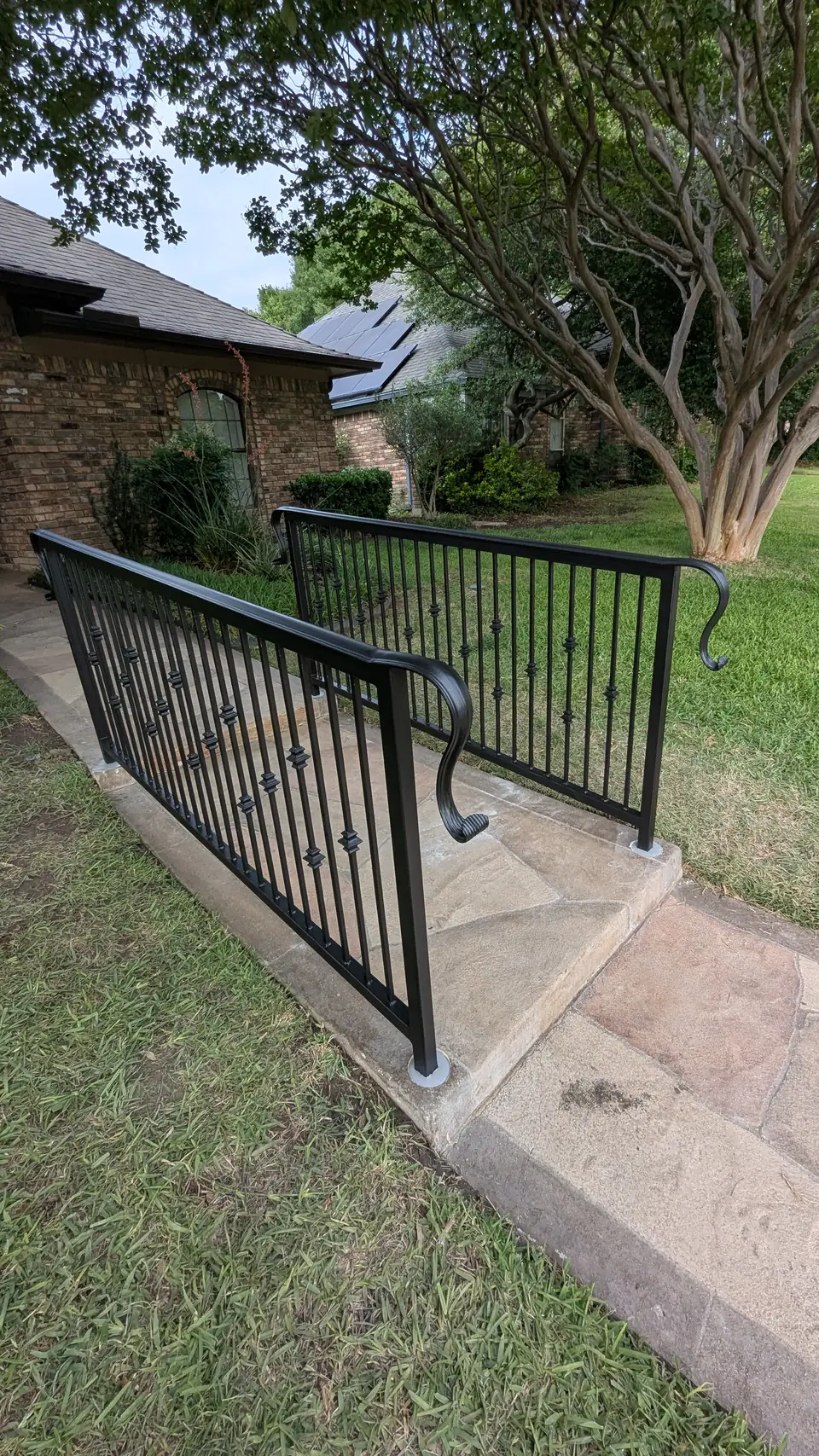
The DFW Handyman welds and installs railings, gates and stairs, and offers galvanizing and powder coating; wrought iron railing work and a welded front walk handrail are among Daniel's projects. See welding and metalwork and bespoke projects, or start a service request.